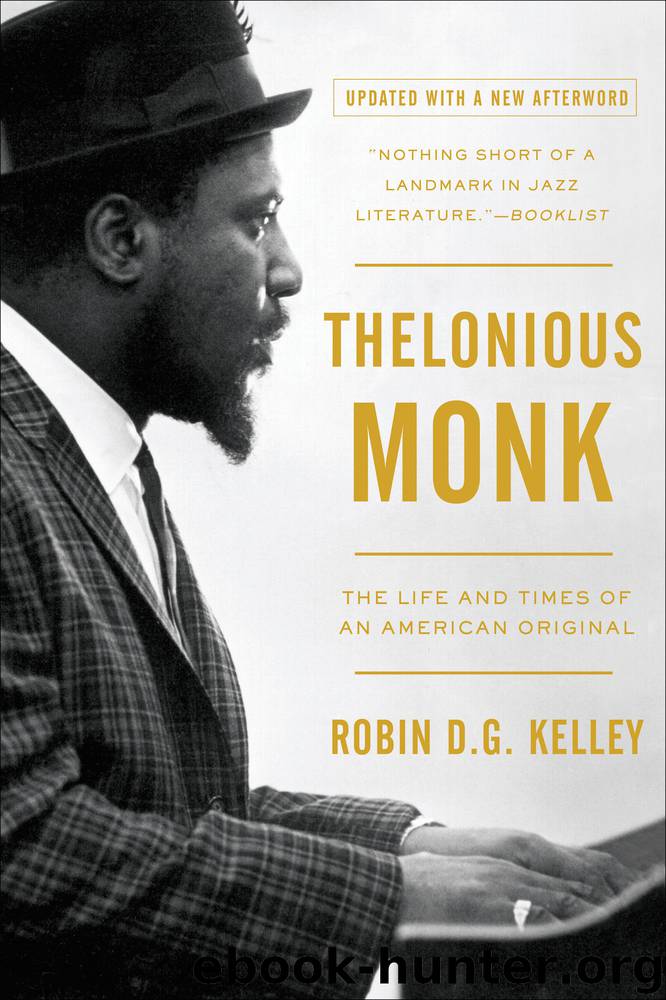
Thelonious Monk by Robin Kelley
Author:Robin Kelley
Language: eng
Format: epub
Publisher: Free Press
25
* * *
“That’s a Drag Picture They’re Paintin’ of Me”
(September 1963–August 1964)
Thelonious worked the day Ronnie died and the day of the funeral. Fans who crowded into the Five Spot each night had no clue how much their hero was suffering. Many came to see the eccentric genius do his thing, so if he danced to the bar and drank himself numb, or spun himself into a kind of mental seclusion, most would chalk it up to his performance. It wasn’t that hard for Monk to mentally and emotionally withdraw before the audience’s eyes because his shows had become routine. So routine, in fact, that even the critics who once adored Monk had begun to complain. Thelonious typically breezed in around 11:00 p.m., made a beeline for the kitchen to drop off his coat and maybe get a quick bite, ambled to the bar to pick up his doubleshot of Old Grand-Dad bourbon, arriving finally at the piano, where he’d launch in to an unaccompanied piece such as “Don’t Blame Me.” He would then turn the proceedings over to Frankie Dunlop for what impatient Monk fans regarded as an interminably long drum solo, returning to the bandstand long enough to announce “Butch Warren will play a bass solo.” Meanwhile, Thelonious would disappear to the back or head straight to the bar. Finally, he’d call the quartet together and they would play four or five tunes, closing out what usually amounted to a forty- or fifty-minute set with “Epistrophy.” And during these tunes he’d often lay out, dancing near the piano or in the alcove behind the bandstand. He’d repeat the same routine over the course of four sets each night.1
The repertoire might have been limited, but he knew how to make the same songs sound fresh each time. The fans kept coming because Thelonious always created excitement and the band always swung. But the routine sometimes dulled the sense of adventure that had come to define Monk’s music. Critic/poet Amiri Baraka worried that Thelonious was playing himself into a cul-de-sac, suggesting that his sudden fame and the backing of a big record label might be the culprits. He warned, “once [an artist] had made it safely to the ‘top’, [he] either stopped putting out or began to imitate himself so dreadfully that early records began to have more value than new records or in-person appearances. . . . So Monk, someone might think taking a quick glance, has really been set up for something bad to happen to his playing.” To some degree, Baraka thought this was already happening, and he placed much of the blame on his sidemen. “[S]ometimes,” he conceded, “one wishes Monk’s group wasn’t so polished and impeccable, and that he had some musicians with him who would be willing to extend themselves a little further, dig a little deeper into the music and get out there somewhere near where Monk is, and where his compositions always point to.” 2
Baraka wasn’t entirely off. Thelonious worked with an excellent group of musicians, but he hardly had a “great” band.
Download
This site does not store any files on its server. We only index and link to content provided by other sites. Please contact the content providers to delete copyright contents if any and email us, we'll remove relevant links or contents immediately.
The Goal (Off-Campus #4) by Elle Kennedy(13679)
Kathy Andrews Collection by Kathy Andrews(11840)
Diary of a Player by Brad Paisley(7584)
Assassin’s Fate by Robin Hobb(6226)
What Does This Button Do? by Bruce Dickinson(6209)
Big Little Lies by Liane Moriarty(5806)
Altered Sensations by David Pantalony(5106)
Pale Blue Dot by Carl Sagan(5012)
Sticky Fingers by Joe Hagan(4204)
The Death of the Heart by Elizabeth Bowen(3625)
The Heroin Diaries by Nikki Sixx(3552)
Confessions of a Video Vixen by Karrine Steffans(3312)
Beneath These Shadows by Meghan March(3311)
How Music Works by David Byrne(3272)
The Help by Kathryn Stockett(3152)
Jam by Jam (epub)(3095)
Harry Potter 4 - Harry Potter and The Goblet of Fire by J.K.Rowling(3076)
Computational Linguistics and Intelligent Text Processing: 20th International Conference, CICLing 2019 La Rochelle, France, April 7â13, 2019 Revised Selected Papers, Part I by Alexander Gelbukh(2996)
Strange Fascination: David Bowie: The Definitive Story by David Buckley(2873)
